
How the 2020 Flying Spur is Everything a Bentley Sedan Should be

Third time’s the charm. The 2020 Bentley Flying Spur banishes forever the visual awkwardness of its two Phaeton-platformed predecessors. It’s long and low, expressively elegant, and glitteringly powerful, with just a soupcon of the jaunty exuberance that’s at the heart of the brand. It’s exactly how a modern Bentley sedan should be.
The enabling technology, of course, is VW Group’s versatile MSB vehicle architecture. Designed to accommodate longitudinally mounted engines all the way up to the 6.0-liter W-12, with all- or rear-wheel drive, MSB has allowed the team under Bentley design chief Stefan Sielaff to give the new Flying Spur classic British luxury car proportions. The 2020 model is a mere 0.6 inches longer than the outgoing car, but its front axle centerline is 5.1 inches further forward, allowing a long hood without a pronounced front overhang. It’s the singular dimensional change that, visually, changes everything.
The MSB architecture debuted on the Porsche Panamera and now also underpins the current Continental GT. In Flying Spur configuration—the largest vehicle yet built on MSB—it shares all the structure ahead of the firewall with the Panamera and Continental GT, and its center section with the long-wheelbase Panamera Executive. The rear section of the platform, however, from the base of the rear seatback, is unique to the Bentley. It allows for a more comfort-oriented suspension setup and a roomy, conventional trunk instead of the Porsche hatchback.
ll exterior panels are aluminum—Bentley claims the new multi-metal body structure is 84 pounds lighter than the outgoing Flying Spur’s. Key design elements include a broad grille with classic vertical slats, crisply defined haunches over the rear wheels, and a C-pillar that sweeps down into the trunk, which falls away slightly to give a hint of the graceful tail-down stance characteristic of the original H.J. Mulliner-bodied Flying Spur of the late 1950s. Standard wheels are 21 inches, with two different 22s available as an option.
Under the hood is the latest iteration of the 6.0-liter W-12, first seen in the Continental GT Coupe and Convertible. That means 626 horsepower, and a herculean 664 lb-ft of torque that arrives in less than one-third the time it took in the previous car. As in the Contis, the engine drives all four wheels through an eight-speed dual-clutch transmission. And despite lugging around extra doors and larger rear seats, Bentley claims the Flying Spur will be just as quick as the Continental GT Convertible, hitting 60 mph in just 3.7 seconds with a top speed of 207 mph. To cope with its prodigious turn of speed, the Flying Spur uses the same 16.5-inch front brakes—the largest iron brake rotors in the world—as the Continental GTs.
The new Flying Spur promises to be a much sportier drive than previous models, with sharper turn-in response, less understeer, and better chassis balance. The three-chamber air springs—similar to those fitted to the Continental GTs—have 60 percent more capacity, allowing for finer degrees of adjustment, and the 48-voly anti-roll system uses electric motors to twist the rollbars against the cornering loads keeping the car flat through turns.

Although the Flying Spur is all-wheel drive, the torque split is resolutely biased to the rear: Comfort and Normal modes allow a maximum of 38 percent of the torque to be sent to the front wheels, but selecting Sport mode caps that at 17 percent. Finally, the Flying Spur will come standard with rear-wheel steering—the first ever Bentley to be so equipped—to improve agility in tight corners and enhance stability through high-speed sweepers.
Modern Bentley interiors have become a byword for extraordinarily rich combinations of color and materials, and the 2020 Flying Spur’s interior is arguably the best yet. Bentley offers no fewer than 15 different standard leather colors, and these can be mixed and matched via a number of dramatic color splits. In addition, buyers can choose from eight different wood veneers, including a new crown-cut walnut, and all can be ordered in the dual veneer specification to give the cabin an even more bespoke feel. The Flying Spur interior’s showstoppers are an optional three-dimensional diamond quilting effect—in leather or wood—on the door trims, and an optional etched finish on the center console made up of 5,331 individual diamond shapes, each different from the others.
The MSB hardware includes a new electrical architecture, so the 2020 Flying Spur comes equipped with a host of driver assistance systems, including traffic and blind-spot warning, as well as night vision, a head-up display, a 360-degree overhead view camera system, and parking assist. When you press the engine start button, the veneered section in the middle of the dashboard rotates to reveal the 12.3-inch HD touchscreen shared with the Conti twins. The second side of the display reveals three analog dials showing outside https://autoconcierge.net/wp-content/uploads/2019/01/Storage-2-copy-1.jpgerature, a compass, and a chronometer. Those wanting what Bentley calls a ‘digital detox’ can select a third side, which is simply finished in plain veneer matching the rest of the cabin.
Rear-seat passengers can control a number of functions—including window blinds, rear seat massage, rear climate control, and mood lighting—via a 5.1-inch touchscreen remote that unclips from the rear of the center console.

Flying Spur buyers can choose from three audio systems. The standard system has 10 speakers and 650 watts. Next up is a 1,500-watt, 16-speaker Bang & Olufsen system with illuminated grilles and the intuitive one-touch BeoSonic user interface. Top of the range is a monster 2,200-watt Naim for Bentley system with 19 speakers and active bass transducers built into the front seats.
The 2020 Bentley Flying Spur will be available for order this fall, with first deliveries expected early next year. No word on pricing yet, but if Bentley follows past form and prices and the new Flying Spur rings in below a comparably equipped Continental GT Coupe, this impressively fast, imposingly glamorous four-door could well be the pick of the Bentley lineup.
By: Angus MacKenzie, June 11, 2019
For more cars, visit: https://www.motortrend.com/reviews/2020-bentley-flying-spur-first-look-review
Source: https://www.motortrend.com/
The 2020 BMW M8 Packs up to 617 Horsepower and Selectable All-Wheel Drive
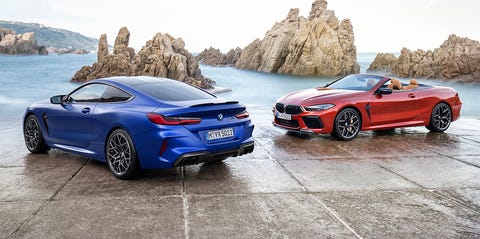
After numerous leaks and several spy videos from the Nurburgring, BMW has finally revealed the M8—the spiritual successor to the recent M6 and the very top of the company’s performance lineup. Available as a coupe or convertible, it packs the twin-turbo V-8 and all-wheel drive powertrain from the M5, along with a whole bunch of other improvements over the lesser M850i that we reviewed in late 2018.
The base M8 coupe and convertible produce 600 horsepower and 553 lb-ft of torque, while Competition models get an extra 17 hp. Performance promises to be exceptional: BMW says the standard M8 coupe is capable of 0-60 mph in just 3.1 seconds, and the convertible will do it in 3.2. With the Competition package, those numbers drop by a tenth. Top speed for all models is electronically limited to 155 mph, increasing to 189 mph with the optional M driver’s package.
Like the M5, the M8’s all-wheel drive system has three selectable modes: A default 4WD setting meant for normal driving, a 4WD Sport setting that sends more power to the rear wheels, and 2WD mode that’s only active when stability control is turned off. An active rear differential works with the car’s M Dynamic mode to allow a degree of wheel slip for controlled oversteer.
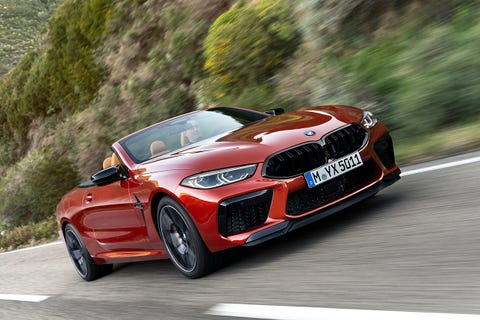
The suspension and frame have been overhauled to withstand more load with things like forged links, a steel X-brace, and a struts that connect the shock towers to the bulkhead. All versions of the M8 come standard with adaptive suspension and 20-inch alloy wheels and summer performance tires. The two-mode brake-by-wire system can emulate a long, soft pedal travel in one mode, and a short, grabby feel in another—but frankly, this capability seems a bit unnecessary to us.
Lamborghini Huracan Serrato First Look: The Off-Road Supercar

Like the Spanish Inquisition, nobody expects the Sterrato! But here we are. Yes, friends, you are looking at a jacked-up, armor-plated, balloon-tired, off-road Lamborghini Huracán. For real? Yes, Lamborghini really built one. In fact, it built more than one, and I’ve already driven it, but drive impressions are embargoed until June 12. Because I can’t tell you if it’s any good (hint: no comment), allow me to share some details.
The Sterrato exists because while Lamborghini was developing the Urus, the engineering team fell in love with off-roading. As you might imagine, the makers of Aventadors and Huracáns had zero experience playing around in sand, mud, and gravel. As any off-roading aficionado can tell you, dirt’s a lot of fun! The Lamborghini team took what it learned from the Urus and applied it to a Huracán. Sterrato, roughly translated, means “dirt road.” The result is something truly unique. As Lamborghini the brand is fond of saying, “Expect the unexpected.”
Four big things turn a 630-hp Huracán Evo into a Sterrato. First comes stance. Lamborghini added 47mm (1.85 inches) of ride height while widening the track by 30mm (1.2 inches) front and rear. Next comes big, fat off-road tires. Made by Pirreli, the prototype meats are much, much fatter than the typical rubber found on a supercar. The sidewall looks to be three times thicker. So thick, in fact, that the front axle had to be moved forward, which required new front control arms. Moreover, the widened track necessitated the 3-D printing of new fenders front and rear.

After that came the armor. The nose, side sills, and rear end all get tough aluminum cladding. Lamborghini claims the plating was added to the spots that took damage during testing. And because the Sterrato is a Lamborghini, the rear piece is a functional diffuser. You can also see shields in front of the huge side intakes. Gotta keep the rocks out. Finally, the Evo’s Lamborghini Dynamic Vehicle Integration (LDVI) computers have been reprogrammed for dirt roads. LDVI controls the magnetic dampers, the torque-vectoring AWD, all-wheel steering, traction control, and the predictive yaw control (Lamborghini Piattaforma Inerziale).
Lamborghini also tossed on some hella-bright LED light bars for good measure. Why not?
The decision to put the Sterrato into production hasn’t been made. Yet. Is there a business case? Sure, assuming people buy them. Will people buy an off-road supercar? That’s the multimillion-dollar question. I imagine Ford went through a similar process when deciding whether to put the Raptor into series production. I believe we can all agree that flying truck is a runaway success story. This is different, but in a way, it’s not that different. Of course, the deciding factor for production will no doubt be how the Sterrato drives, especially off-road. In just eight short days from now, I’ll tell you all about it. Until June 12!
By: Jonny Lieberman, Jun 4, 2019
For more cars, visit: https://www.motortrend.com/news/2020-lamborghini-huracan-evo-first-drive-review
Source: https://www.motortrend.com/
Jaguar XE SV Project 8 First Test: Exclusive and Extreme

The Jaguar XE SV Project 8 has an insatiable appetite for breaking records. First, it shattered the four-door production sedan lap time at the Nurburgring with a time of 7:21.23. That’s 11 seconds quicker than the Alfa Romeo Giulia Quadrifoglio, the former record-holder and our 2018 Car of the Year. Then, just last year, MotorTrend pro racer Randy Pobst set a production sedan lap record of 1:37.54 at WeatherTech Laguna Seca, eclipsing the 1:38.52 set previously by a 2016 Cadillac CTS-V.
What else would you expect from a Jaguar XE that looks like it’s been injected with massive amounts of steroids and carbon fiber? With a supercharged 5.0-liter V-8 cranking out 592 horsepower, the Project 8 is also Jaguar’s most powerful roadgoing car to date.
But in light of these accomplishments, Jaguar insists that it’s a worthy roadgoing car as well. That’s right—despite the bespoke bodywork, the pavement-sniffing splitter, and the massive wing out back, “compromise was not in the nature of this product,” according to one of the Project 8’s lead engineers. And you know what? They’re right. Out on the road, the Project 8 is comfortable—even practical. Although EPA estimates fuel economy to be 16/22 city/highway, we observed an indicated 25 mpg during extended stints on the freeway. This fearsome cat is also a cuddly kitty.
Then again, it had better be. The base price of the Project 8 is a blood-chilling $188,495. That’s far more than such four-door performance heavyweights as the BMW M5 ($104,595), the Mercedes-AMG E 63 S ($105,395), or the Porsche Panamera Turbo S E-Hybrid. It’s more than twice the price of the aforementioned Alfa, which starts at a comparatively thrifty $75,590. None of these models, however, can boast a claimed 200-mph top speed. So there’s that.
Our Velocity Blue tester featured a slew of options that were thoughtfully included at no cost. Some were appreciated, such as the 825-watt Meridian sound system and the trick 20-inch wheels, whose design resembles reverse five-spokes. We could have done without the giant cat vinyl decal gracing the flanks of the sheetmetal, however. And for a record-breaking sports car, the front seats are a letdown. While the upper portion cradles the torso nicely, the bottom offers no lateral support to speak of. Outside of North America, buyers can choose a two-seat Track Pack option that offers carbon-fiber shells with four-point harnesses. Lucky.

This Is the SF90 Stradale, The Most Powerful Ferrari Ever
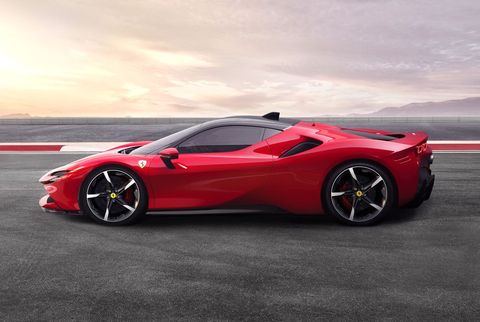
This is the future of Ferrari: Meet the SF90 Stradale, the automaker’s first mainstream production plug-in hybrid hypercar. It packs 986 horsepower from a twin-turbo V-8 augmented by three electric motors, and it establishes itself as Ferrari’s new pinnacle.

This marks the first time a V-8 car has occupied the top of the Ferrari lineup. The SF90’s drivetrain centers around a modified version of the company’s twin-turbo V-8. Bored out to 4 liters of displacement and blessed with improved intake and exhaust routing, the engine makes 769 hp and 590 lb-ft of torque on its own.
An additional 217 hp comes from three electric motors—one powering each front wheel, and one stacked between the engine and gearbox. Powered by a 7.9 kWh lithium-ion battery mounted just behind the passenger compartment and spanning the width of the chassis, the car can cover up to 15.5 miles in electric-only mode, and can reach a maximum speed of 84 mph on battery power. A humorous point: Technically, when operating in EV-only mode, this is the world’s first front-wheel drive Ferrari.

But the hybrid system isn’t just there to save fuel. This is the first mid-engine Ferrari supercar with all-wheel drive, and the SF90 Stradale uses all that traction for major acceleration. Ferrari promises the car will do 0-62mph in 2.5 seconds and 0-124mph in 6.7 seconds, quicker than the V-12 hybrid LaFerrari. The electric motors powering each front wheel also enable real-time front-axle torque vectoring for improved handling on track.
The SF90 Stradale features an all-new eight-speed dual-clutch transmission. The dry-sump gearbox allows the drivetrain to sit 15 mm lower than the previous seven-speed dual-clutch, lowering the car’s center of gravity. The additional gear makes up, in part, for the relatively low redline of the updated V-8 engine—8000 RPM, compared to the LaFerrari’s 9250-rpm V-12. Notably, the transmission does not have a reverse gear—the car backs up using the front-wheel electric motors, a strategy also used in the Acura NSX.
In person, the engine appears to sit impossibly low in the chassis. Peering through the glass engine cover, there’s about two feet of open-air space above the engine itself. You could slide a carry-on suitcase in the space, if you weren’t afraid of it catching fire.

The SF90 Stradale’s interior embraces minimalism. There are no physical buttons anywhere on the dashboard—pretty much everything is capacitive touch. Nearly every driving-related control is located on the steering wheel, while climate controls reside on a capacitive-touch pod to the right of the steering wheel. Gear selection is done by three push-pull toggles on the transmission hump, designed to be reminiscent of a gated manual shifter, while steering wheel paddles handle up- and downshift duties.
The instrument panel is entirely digital, made up of a giant 16-inch curved display screen that encompasses gauge readouts and navigation display. This is also the first Ferrari road car with head-up display.

As with all modern hypercars, the SF90 Stradale has active aero features. Instead of a rear spoiler that rises above a certain speed, the new Ferrari’s rear aero activates by lowering a wedge-shaped panel directly ahead of the rear edge of the bodywork, revealing a large Gurney flap-style spoiler. This fast-acting aero system allows the car to go into low-drag mode on straightaways and increase downforce under braking or cornering. The system can generate up to 860 lbs of downforce at 155 mph.

An even higher-performance version, the SF90 Stradale Assetto Fiorano, will be available as well. Shown here in silver, the Assetto Fiorano features upgraded shock absorbers, lightweight titanium springs and exhaust, carbon-fiber wheels and other weight-savings measures for a total of 66 lbs of weight savings. Thus equipped, the SF90 weighs in at 3461 lbs dry—certainly not light, but a few pounds less weighty than the LaFerrari. The Assetto Fiorano also offers greater downforce and more grip thanks to Michelin Pilot Sport Cup2 tires (an upgrade from the standard-equipment Pirelli P Zeros).
This is the first Ferrari to use brake-by-wire technology, allowing braking duties to be split between the traditional hydraulic system and the regenerative capability of the electric motors. The hybrid Acura NSX uses a similar system, as does the Alfa Romeo Giulia and Stelvio. Our experience with the Alfa system has been less than ideal, so we’re curious to see how brake-by-wire works in Ferrari’s application.
The SF90 Stradale is named to commemorate the 90th anniversary of the founding of the Scuderia Ferrari racing team. As such, it’s meant to embody the flow of technology from Ferrari’s racing operation to its road cars. In person, the SF90’s voluptuous bodywork evokes Ferrari prototype racers of the 1960s and ’70s, while the hybrid technology nods to modern Formula 1. In total, the SF90 Stradale is a stunning new direction for Ferrari, one that’s sure to influence many of the next-generation models the automaker promises will debut soon. As for price? Ferrari representatives would only say that the SF90 Stradale will be more expensive than the current F12 Tributo, but less than the LaFerrari. Deliveries begin in the first quarter of 2020.
By: Bob Sorokanish, May 29, 2019
For more cars, visit: https://www.roadandtrack.com/new-cars/future-cars/a27626676/ferrari-sf90-stradale-hybrid-hypercar-power-specs-photos/
Source: https://www.roadandtrack.com/
Aston Has Built a Bond-Themed DBS Superleggera

Aston Martins shouldn’t really try to ram home the James Bond connection so explicitly, should they? After all, most sentient beings are well versed in the irrefutable fact that James Bond = Aston Martin. And vice versa.
Exhibit A: this new ‘On Her Majesty’s Secret Service DBS Superleggera’,which references 50 years since, well, On Her Majesty’s Secret Service was first released into cinemas. You may or may not remember, in that 1969 film James Bond (George Lazenby) drove a DBS. In Olive Green.
And lo, this new DBS Superleggera gets an Olive Green paint job too. Which is good, because green is a good car colour. Don’t @ us.
Elsewhere, the OHMSS DBS features wild, intricately designed forged alloys (diamond-turned, no less), much carbon fibre, an aero blade and a new splitter. The grille gets six horizontal vanes for a better homage to that 1969 movie car.
Inside, it’s black leather with red striping, some Alcantara, and the option of a bespoke drinks case that slots into the boot. Naturally, there are badges all over the place to remind you that yes, James Bond = Aston Martin. And vice versa. At some point, you will have to explain these badges to someone.

The 2020 BMW M5 Edition 35 Years Is a Subtle Tribute
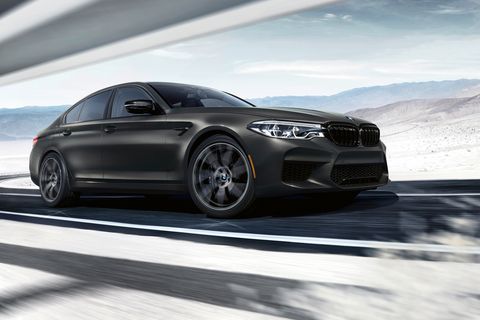
When the BMW M5 first came to the US in 1986, you could only have it in black. A subtle treatment for one of the fastest four-doors the world had yet seen, and a car that established a legend. To celebrate 35 years of M5—Europeans first got this model in 1984—BMW has created the M5 Edition 35 Years, with subtle looks that seem to pay tribute to the E28s the company brought to America.
Only one shade is available for this car—Frozen Dark Grey II, a matte paint. The wheels are painted graphite gray, while the kidney grilles, brake calipers and tailpipes are black. And around back, you’ll find no M5 badge. Those who not in the know will just think this is a grey sedan; not the monster it is in reality.
Inside is where things get lavish. There’s gold anodized aluminum trim grained to look like carbon fiber, and full leather interior with stitching to match the trim. The center console is engraved with “M5 Edition 35 Jahre” to let passengers know just how special this car is.
The M5 Edition 35 Years is based on the M5 Competition, which packs a 617-hp 4.4-liter twin-turbo V-8 with an eight-speed automatic and a clever all-wheel drive system. It comes standard with the M Driver’s Package, which bumps top speed from 155 to 189 mph, and all the luxury and safety goodies you get with the M5’s otherwise-optional Executive Package.
BMW will make 350 examples of the M5 Edition 35 Years, and 35 of those will come to the US. The price is set at $129,000 including destination and the M5’s mandatory Gas-Guzzler tax. A similarly equipped M5 Competition would set you back $122,000, and you could always take the badge off the back. You won’t get the gold trim, though.
The 2020 McLaren GT Is a Mid-Engined Supercar Built for Luxurious Grand Touring
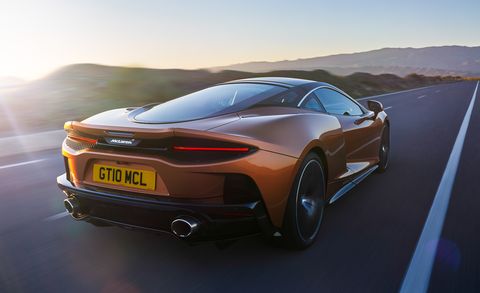
England’s posher automakers seem to be engaged in an artillery duel. Recently, Aston Martin has announced plans to launch two mid-engined supercars clearly aimed at Ferrari, Lamborghini, and McLaren, as previewed by the AM-RB 003 and Vanquish concepts. Now McLaren seems to be getting its retaliation in first with a car whose luxurious mission is implicit within its name: the GT.
Of course, McLaren has used GT branding before, but the outgoing 570GT was a member of the brand’s entry Sports Series. The new GT—which stands for Grand Tourer—is a model in its own right, and McLaren says it doesn’t fit into the existing model hierarchy of Sports, Super, and Ultimate Series. We’re promised it will offer unprecedented levels of both practicality and comfort, despite having a mid-mounted powerplant in a part of the market where cars traditionally stow their engines up front.

The GT’s most obvious disadvantage is its relative lack of passenger accommodation. In a segment where almost every significant rival offers at least plus-two practicality it remains a strict two-seater; the massively more expensive three-seat Speedtail remains the only McLaren for those who want to travel with more than one passenger.
But it is definitely the most practical McLaren yet. Underneath, the GT sits on a modified version of McLaren’s carbon-fiber tub, the Monocell-T (for Touring). This incorporates an additional carbon frame at the rear, which allows for the large hatchback that gives access to the luggage space positioned above the engine.
While this is similar in principle to the compartment that sat at the back of the 570GT, the new rear luggage space is much larger: 14.8 cubic feet, according to McLaren, which makes it capable of accommodating both a full-size set of golf clubs and two flight bags at the same time. That’s why the decision was taken to move away from the 570GT‘s side-hinged glass cover to a more conventional rear-hinged tailgate.
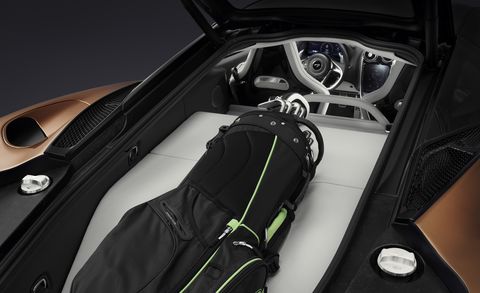
“It’s much easier to put something heavy in from the back than the side,” Tom Taylor, McLaren’s global product manager, said as he talked us around the car. The tailgate will also come with the option of power operation, a first for McLaren. With an additional 5.3 cubic feett of volume in the front compartment, the GT has more room for luggage than any competitor.
While the GT won’t have the interconnected hydraulic dampers of the more expensive 720S, it does get active shock absorbers under the control of what McLaren calls its Proactive Damping Control system, which are able to react to changing road conditions in as little as two milliseconds. We’re told to expect the most compliant ride from any McLaren, even on standard 21-inch rear wheels (with 20s at the front). Ride height has been increased over other McLarens, with a minimum of 4.3 inches of clearance under the car and a 10-degree approach angle beneath the front splitter, reducing anxiety about expensive grinding noises.
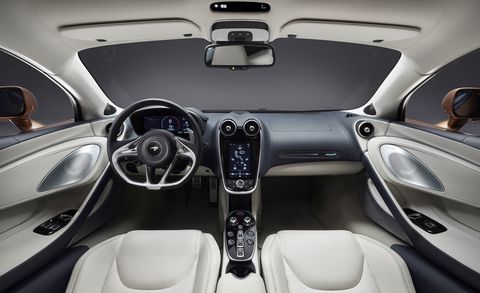
Power comes from a reworked version of the 4.0-liter twin-turbo V-8, as seen in the 720S, with sufficient changes to have been awarded a new design code: M840TE. The engine has new smaller turbochargers to improve responsiveness at lower speeds. Peak power is 612 horsepower at 7500 rpm, but although the maximum 465 lb-ft of torque arrives at 5500 rpm, Taylor says the GT has been engineered to be happy when operating at a scant percentage of its potential, with 95 percent of the torque peak already present at 3500 rpm.
The exhaust soundtrack has been engineered to have the bass-heavy harmonics that buyers reportedly associate with grand tourers. Refinement hasn’t come at the expense of performance, which will still be brutal. McLaren quotes a 3.1-second zero-to-60-mph time, a 9.0-second zero-to-124-mph time, and a 203-mph top speed.
According to McLaren design director Rob Melville, the GT has been styled to have a “less intense visual appearance” than its sportier sisters. It is longer than both the 570GT, with an overall length of 184.4 inches making it 6.1 inches bigger. It is only slightly taller though, at 47.8 inches, so only half an inch—with Melville saying much of his design team’s effort was expended on giving it the visual heft more appropriate to a grand tourer with a higher nose and clean surfacing.

Less demanding aerodynamic targets have allowed the GT to have some cleaner design; its doors don’t have the integral air channels of the S-suffix models, and both front and rear bumpers have more structure and less gap.
“It’s not about chasing drag targets or huge power,” Melville says. “What we wanted for the GT was a very simple, clean, bold design.”
By: Mike Duff, May 15, 2019
For more on the McLaren GT, visit: https://www.caranddriver.com/news/a27458479/2020-mclaren-gt-photos-info/
Source: https://www.caranddriver.com/
The Oldest-Surviving Porsche Will Probably Fetch $20 Million at Auction
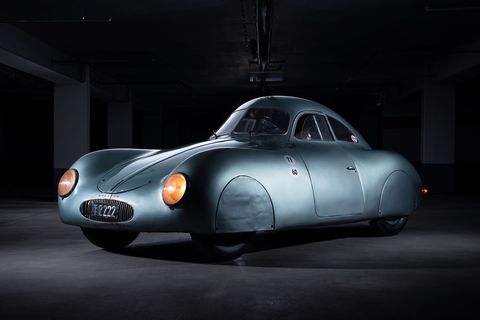
In a press release announcing the upcoming sale of the car you see here, auction house RM Sotheby’s declares it “the most significant surviving piece of Porsche engineering and design history.” It’s hard to argue with that, since this is believed to be the oldest-surviving Porsche. It’s so old, it actually predates the company by nearly a decade.
This car is a Type 64, which Ferdinand Porsche designed for a 1500-kilometer race between Berlin and Rome planned for September 1939. It was based on the Porsche-designed Volkswagen Beetle—then known as the KdF Wagen—but fit with streamlined aluminum body panels and a hotter 32-hp flat-four. The race never happened. Nazi Germany invaded Poland in September, 1939, and the Type 64 project was effectively cancelled. One car was built, which became property of the German government.
Ferdinand’s son Ferry built two more examples of the Type 64, though. Chassis #2 was completed in December, 1939, and chassis #3 was finished the following June. Type 64 #3 actually used the bones of the first car, which was crashed by the managing director of Volkswagen. While Type 64 #2 didn’t survive the war, chassis #3 did, and was retained by the Porsche family when they relocated to Austria. Ferry Porsche put the company name on the front of the Type 64, registered it in 1946, and had Battista “Pinin” Farina—who later founded design house Pininfarina—restore it in 1947.
In 1948, Porsche debuted its first car, the 356, and during an early appearance in Austria, Type 64 #3 was at its side. Austrian racer Otto Mathé bought the car from the company in 1949, and raced it extensively in the early 1950s. Mathé kept the car for the rest of his life, and shortly after he died in 1995, it was sold to Dr. Thomas Gruber, himself a Porsche historian.

In August, RM Sotheby’s will auction Type 64 #3 in Monterey, and it’s expected to command at least $20 million. It’s totally original, and it comes with a number of spare parts, too.
To become the most expensive Porsche ever, it has to beat the 917K used in the film Le Mans, which fetched $14 million at auction in 2017. Given its significance and only-one-left status, we expect Type 64 #3 to do so with ease.
This Mad BMW 2002 Has a 792bhp V10 and Weighs Less Than a Tonne

However, that was nothing. Oh no, that little Z4 was just a tame little pup in comparison to the presumably angry Rottweiler that is Gruppe5 Motorsport’s latest creation. The renderings you see above will come to life this summer, and yes, that will be a real BMW 2002 underneath the mother of all carbon body kits.
But why the comparison to the Manhart Z4? Well, the Gruppe5 2002 will also use the S85 V10 from the E60 M5. However, customers will only be able to spec their car in either 5.8-litre, 734bhp trim, or 5.9-litre, 792bhp trim. Crikey.
To cope with all the power (which heads to the rear wheels only) the chassis of the old 2002 will be completely rebuilt by hand using a mixture of carbon fibre and steel, and an FIA-spec roll cage will also be fitted along with a 6-speed sequential gearbox. These cars will be designed as just-about-road-legal racers.
Thanks to all that carbon-fibre, the car will weigh just under one tonne, and thanks to that insane aero it’ll produce around 1.1 tonnes of downforce. Driving on the ceiling anyone?
There’s no word on cost as of yet, but you’ll need to provide your own original 2002 to qualify for the conversion, so don’t expect to be able to fund it by rooting down the back of your sofa. The plans are ambitious though – Gruppe5 expects to build 300 of the things.
The engines will be built by legendary BMW race tuner Steve Dinan, whilst the design will be led by Bill and Bob Riley, who have won 13 overall Daytona Prototype championships as a pairing. So there’s pedigree.
You just would, wouldn’t you?
By: Greg Potts, May 8, 2019
For more cars, visit: https://www.topgear.com/car-news/modified/mad-bmw-2002-has-792bhp-v10-and-weighs-less-tonne
Source: https://www.topgear.com/